How a window display gets made, from brief to install
A finished window reads as one gesture. Behind it sits a long sequence of decisions, and each one exists to remove a risk from the stage after it. Skip one and the cost surfaces later, usually on install night, when it is most expensive to fix.
This is that sequence as we run it, from the first brief to the morning the store opens.
The brief and the brand standards
Everything starts with three things: the vision, the brand standards and the deadline. A useful brief states all three plainly.
- The concept, or the creative direction, and the product the window has to carry.
- The standards that cannot move: color references, finishes, typography, logo rules.
- The date the window must be live, and the stores it applies to.
- What is fixed and what is open. A brief that says where there is room to adapt saves a round of redesign.
Many projects arrive with full creative direction. Others need design development before anything can be drawn. Either way, the brief is the reference every later decision is checked against.
Site survey and measurements
Drawings are only as good as the survey behind them. Every window is measured on site: the glass, the depth of the window bed, the floor and ceiling, existing lighting, the access door and its clearances, and the sightlines from the street.
The survey also records what the drawings cannot show. Where the crew will unload. Which hours the building allows work. Whether a lift is available. On a rollout this matters store by store: for the Panerai holiday rollout, one production run was kitted to each site survey, so five different storefronts received an identical result.
Design development and drawings
The concept becomes a set of drawings: plans, elevations, sections and a schedule of materials and finishes. This is the stage where every decision should be made before production begins. A question answered on paper costs an hour. The same question answered in the shop costs a remake.
Engineering and materials
Engineering decides how the window stands, hangs, lights and survives handling. It covers weight and fixing points, how each element is made safe in a space the public stands beside, where power runs, and how a large piece breaks down to pass through a store door.
Materials are chosen for the effect and for the site. A facade faces weather; a window bed faces heat from lighting and sun through the glass. On the Dior 57th Street facade, structure, graphics and light were engineered as one system, because the standard allowed no visible seam, and Midtown access windows and open weather left no room to improvise.
Prototype and sign-off
Before full production, the critical element is proven. That might be a single prop, a finish sample or a section of a repeating component. It answers the questions a drawing cannot: how the color reads under store lighting, how the edge looks at arm's length, whether the joint disappears.
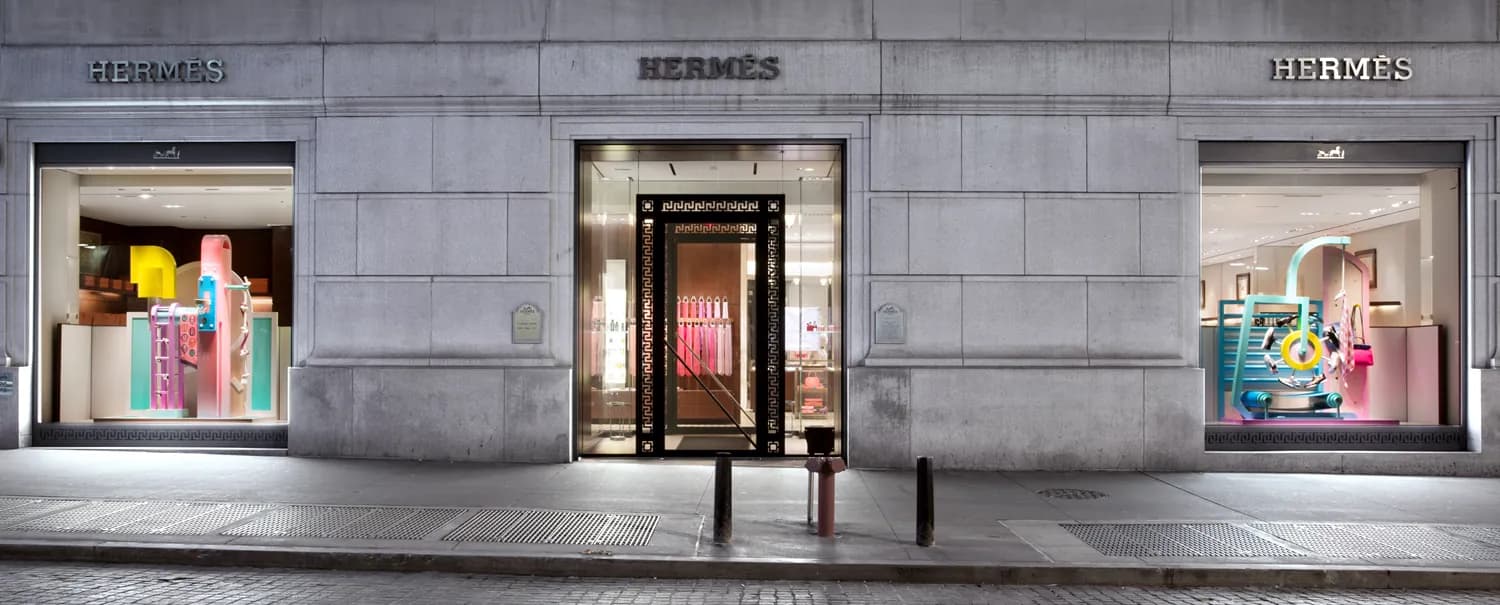
Sign-off happens here, on the physical sample, not on a screen. The Hermès window program is a good example: the props were prototyped and the paint hand-finished, because those scenes are viewed inches from the glass.
Fabrication and print
With drawings and samples approved, production starts in the shop: structures, props, graphics and print, in premium materials. The discipline here is consistency. One perfect piece is craft. Hundreds of identical pieces is a system.
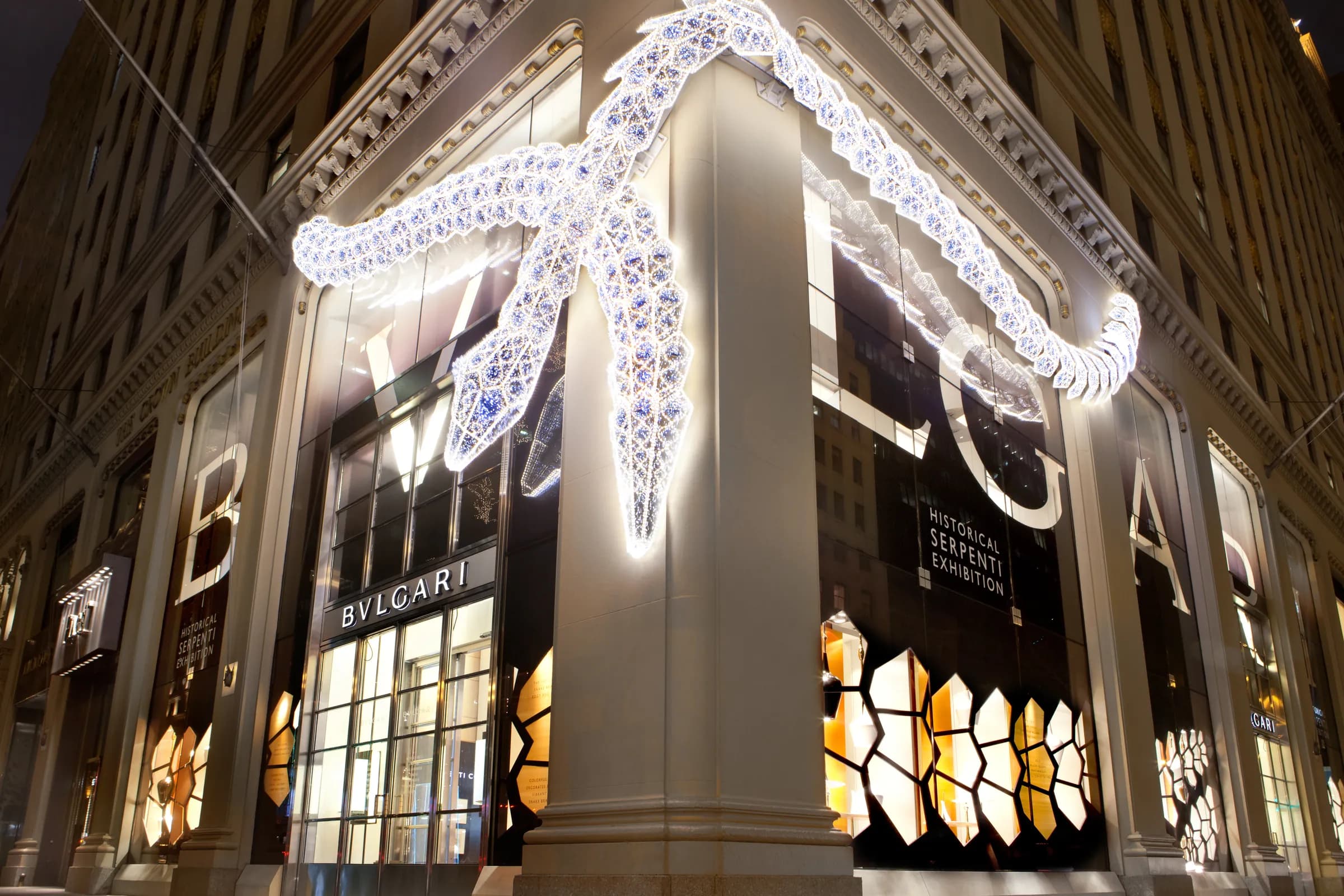
The Bulgari Serpenti build shows the difference. Hundreds of repeating scales had to share every edge exactly, so they were produced as a modular scale system rather than as individual pieces.
Finishing and quality check
Paint, lacquer and edges are finished, then every piece is checked against the approved sample. Wherever possible the scene is assembled in the shop before it ships. A window that has stood up once in the shop goes up faster and more precisely on site. The Dior facade was pre-fitted in our shop; the Hermès scenes were pre-assembled for a precise install.
Quality checks belong before packing, not after unpacking. A flaw found in the shop is a repair. The same flaw found in the store at two in the morning is a compromise.
Packing and freight
Finishes are protected for the journey, crated where needed, and labeled by window and by install sequence. On a rollout, each store's kit is packed separately and checked against that store's survey, so the crew opens exactly what they need, in the order they need it. The Serpenti components were finished and crated in the shop before they traveled.
The install
Most windows go in when the store is closed. The install window is set by the store's hours, the building's rules and, in a mall, the center's own restrictions. Overnight changeovers let a store close on one season and open on the next.
Anything that sits on the street, on a facade or over a sidewalk, may need permits, and those are coordinated well ahead with the schedule, the crew and the freight. Our own crews install, so the people on site know the drawings and the standard.
Styling
Once the structure is in, the window is styled: product placed, light focused, details adjusted. The final checks happen from the sidewalk, at the distance and angle a client will see it, because that is the only view that counts.
The handover
The window is tested, then handed over with its documentation. Lighting runs. Moving or digital elements play. Anything that needs care during the campaign is noted, and maintenance can keep the display in perfect condition until the next change.
Why the sequence matters
None of these stages is unusual on its own. The quality comes from running all of them, in order, with the same standard at each step. When that happens, install night is uneventful, and an uneventful install night is what lets a window look effortless the next morning.