Digital and LED screens in luxury store windows: what works and what it takes
A screen is not a window. Added at the end of a build, it reads as hardware standing in a vitrine. Commissioned at the start, with content, structure, power and service access decided with everything else, it behaves like any other material in the composition. Digital signage in retail earns its place only where print and light fall short.
What a screen does well
Motion. A still window is read in a glance from a moving pavement. Motion holds that glance and can steer the eye to the product.
Change without a rebuild. One window can run different creative across a campaign, or rotate messages within a day, absorbing merchandising that outpaces the build.
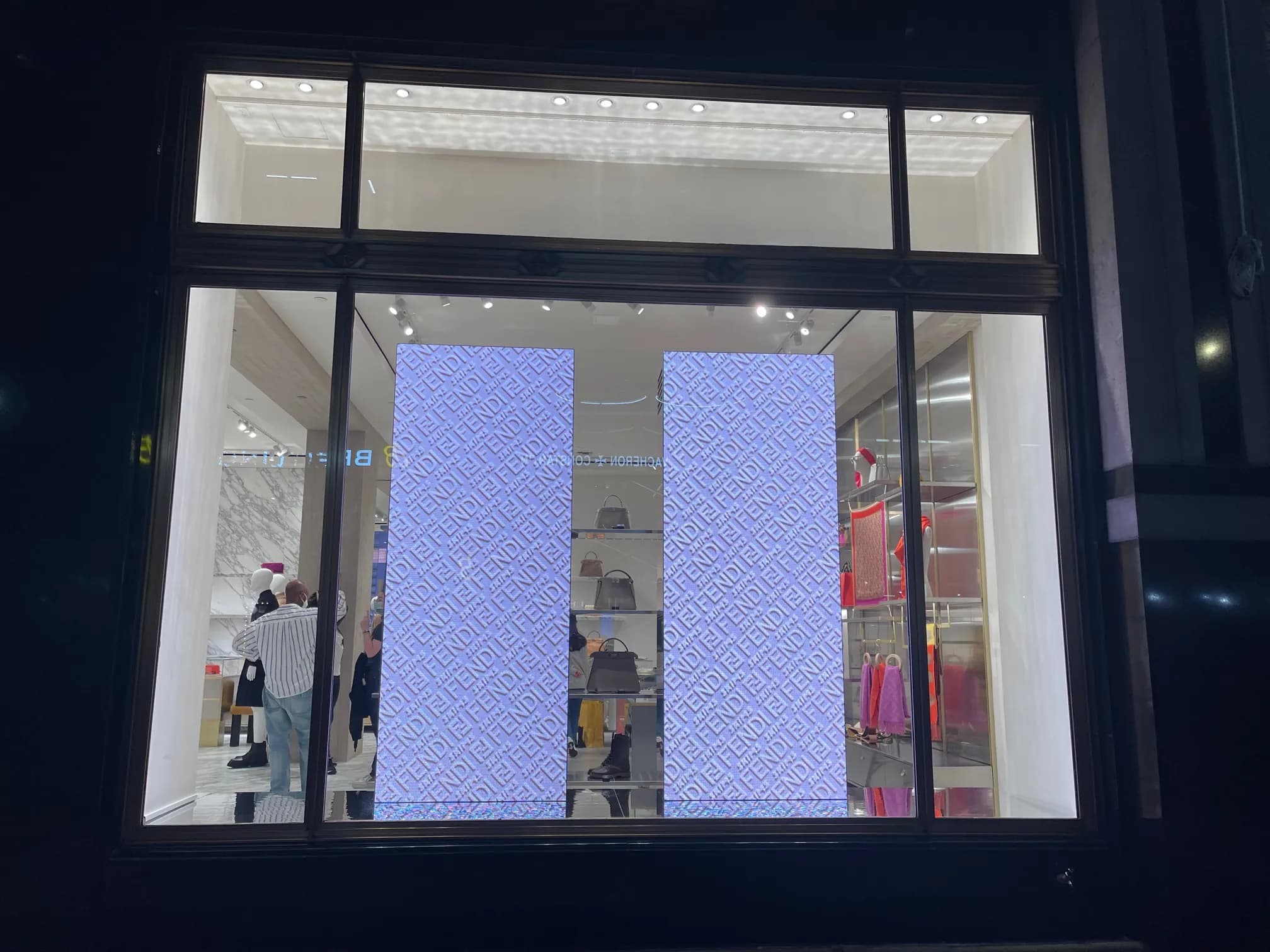
A launch moment. Vertical LED screens ran FF patterns across the windows of the Fendi × Skims launch on 57th Street in New York in 2021, with a pink FF bubble installation inside the store. The pattern was the campaign, repeated and in motion.
Footage. Product film or a reveal, the storytelling that only works in time. An LED display for retail earns its place fastest when the idea is already a film.
What a screen cannot do
Stand in for a composition. A screen does not style product, build depth or answer the architecture around it. Where the rest of the window is thin, it makes that visible: the eye goes to the brightest object and stops.
Beat the daylight. Shop glass faces a street, a sky and a moving sun. Contrast lost to daylight is lost at the hours the pavement is busiest. Glass angle, screen surface, hooding and window lighting are design decisions, not settings changed on install morning.
Live without content. Every screen carries an obligation to make, approve, load and replace content. A loop that is beautiful on first viewing is tired by the hundredth.
Stay a window. A screen brings power, data, a player, a service route and someone to call when a panel dies. All of it is staffed and owned, or it fails silently.
Where a screen earns its cost
| A screen suits | A screen does not suit |
|---|---|
| A launch with a film or a reveal | A window whose job is product and craft, read inches from the glass |
| Creative that changes inside the campaign | A site where the glass takes direct sun |
| Several windows that read as one statement | A brief with no owner for content |
The test is simpler: name the thing the window has to do that print cannot. If the answer is vague, the screen is decoration.
Content comes before hardware
The content spec exists before a screen is chosen, because it decides what the screen has to be: loop length, the pieces that play and their order, and the rules for motion and type.
Loop length follows dwell time: how long someone stands at that glass, how long a passing car takes, how often the same person walks by. A loop for a shop doorway and one for a wide flagship window are different pieces. Type is checked from the far side of the street as well as the near: a line that reads at two paces can disappear at twenty. Approval happens on the screen, in the window, in its light: a file approved on a monitor is not approved.
Screen and structure as one build
A screen in a window is a housing, a frame, a mounting, a ventilation path, a service route and a cable run before it is a picture. Those parts belong in the same drawing as the window's structure, because each constrains the other. A service door that opens into the sightline, a cable that crosses the glass, a bezel that fights a lacquered reveal: each is settled on paper or paid for on site.
The Fendi × Skims build was fabricated off-site, and the screens were integrated, tested and run through before handover. That order is why a launch night can be quiet. The route from survey to handover runs the same way.
Power, data and service access
The store supplies the power and sets its rules. Where the supply enters the window, which circuit the screen sits on and who isolates it at night are questions for the building first. Data follows: where the player lives, whether the store network reaches it, and who holds the key. A panel that needs the glass removed is a fault that stays up for a week.
Testing before handover
The loop runs by day and night, watched from the pavement on both sides of the street. Color is judged on the glass, not on a monitor. The player is restarted, power is cut and restored, and the loop must return on its own. Anything needing a person to reset it will need one at the wrong moment.
A run-through catches the ordinary faults too: a reflection on the product, a frame join that reads from the street, a bright frame that lands as a bus stops outside.
Install on a closed night
Screens go in when the store is shut, usually overnight, and the window's access sets the limit. The screen arrives tested and the structure pre-fitted, so the night goes on placing, connecting and aligning. The last hour belongs to the test.
Who owns the content after launch
Content has an owner, a calendar and an approval route, or the window becomes a still image in a black frame. Name the owner before fabrication: an in-house studio, the campaign agency, or the production house that built the window. Agree who licenses the footage, who signs off a change, and how fast a change can be made once the store opens.
What to decide first
Three questions, in this order. What must the window do that print cannot. Who makes and refreshes the content. Who services the screen when something fails. If two have no answer, the screen is not ready to be specified, whatever the date says.
A screen program is a build with a running cost, and the running cost is mostly people. Planned for, it gives a window that can change with the season. Left out, it gives an expensive poster.
For a window already being planned around a screen, start a screen program with the content owner named in the brief.