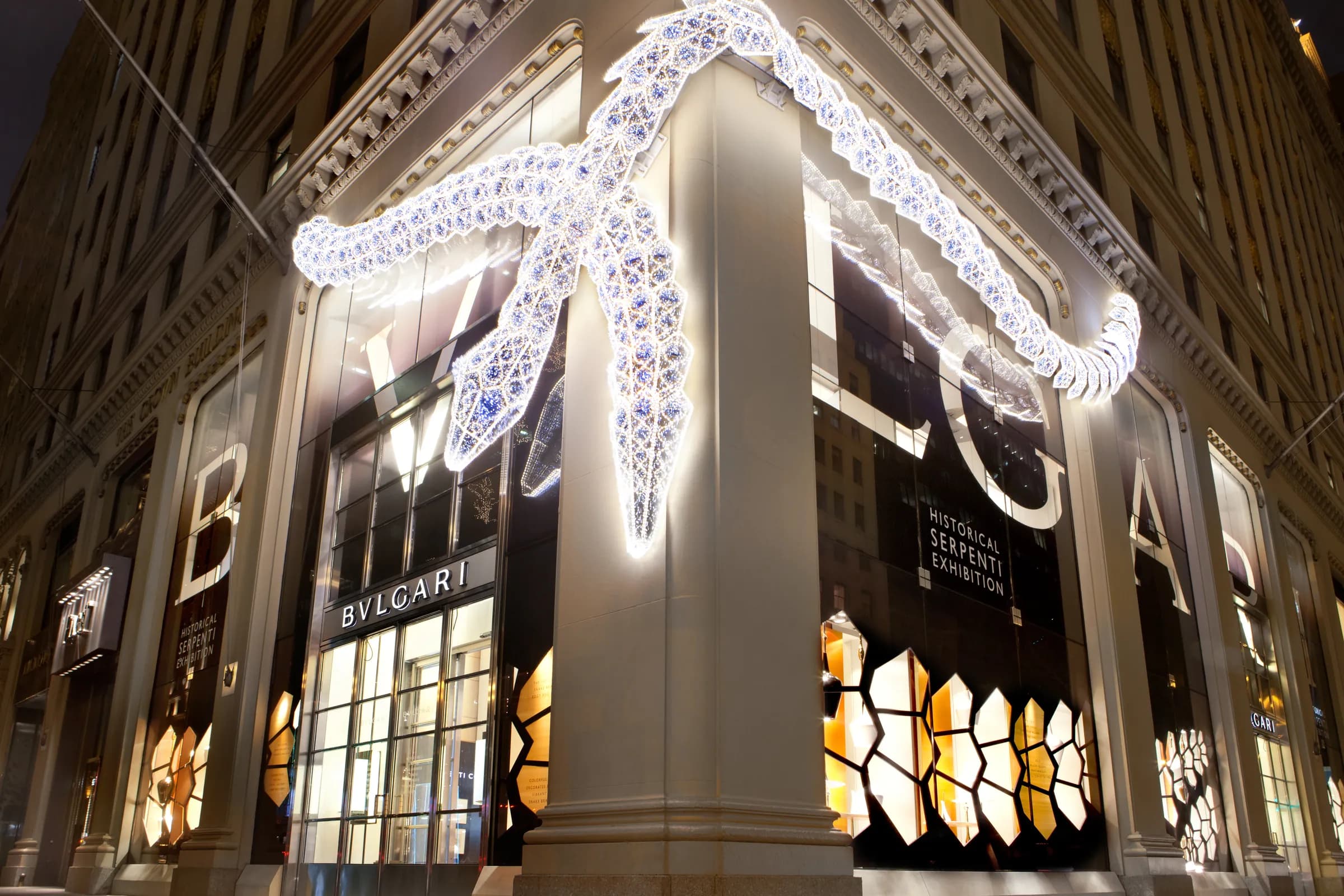
Construction barricade graphics: keeping a flagship on brand through a renovation

While a store is closed for construction, the barricade is the only face it has. It stands where the storefront was, for the same people who will walk into the finished store. That makes it a brand surface, not a construction cover, and the two are specified differently. A cover keeps dust in and people out. A brand surface is bought to be read in passing, in bad weather, at night, beside whatever the neighbor is running that season.
What a barricade has to do
Hold up at walking speed. Almost everyone who sees it is moving, reading it from a distance that closes quickly and often at an angle. That argues for one clear statement and a legible mark, not a panel nobody stops for.
Work day and night. The same surface faces afternoon sun and then streetlight, headlights or nothing. Both are part of the design, not a check at the end.
Survive the weather. Sun, rain, wind, grit off a working street, salt air near water, and the dust of the build itself.
Tell the story of the opening. Whether it names a date is a brand decision, but it should answer the question a passerby has: what is this, and when is it a store again.
Survey and measurement
Survey before demolition. The storefront that exists today is the only reliable record of how the building lines up, and once the glass is out that reference is gone.
Record the line the hoarding or scaffold will take, including the returns at each corner and the setbacks where the facade steps. Set the base line from a fixed point rather than the pavement, which rarely runs true over a flagship. Note what the graphic works around: standpipes, vents, cameras, light fittings, canopies and the doors that still have to open.
Then photograph the site from the opposite curb in overlapping frames, both ways along the street. The photographs show where the view is cut by parked vehicles or a bus shelter, which stretch is seen longest from the corner, and what sits alongside. A pale graphic beside a dark neighbor reads one way, beside a bright one, another.
Engineering and substrate
Most barricades are either a graphic applied to the scaffold already there for the build, or a hoarding built as a flat wall on its own frame.
A wrapped scaffold is tall and already paid for, which lifts the brand above head height. But a wrap turns the scaffold into a sail. Wind load is the first engineering question, and the answer usually involves venting or perforating the material, or confirming the structure was designed for the added load. That is a conversation with the scaffold contractor, not a decision at the printer.
A hoarding gives a flat face, a controlled joint pattern and clean edges, at the cost of building it. Panels are fixed to a frame with the joints set out in advance.
Either way, the joints decide whether the result looks finished. Draw the artwork to the joint grid rather than forcing the grid to fit the artwork, and place every seam in negative space. A seam through a logo cannot be tightened out later. On a wrap the seams follow the structure, so the graphic is drawn around the bays, and the corners, where the material changes plane, are the hardest part.
Print and finish
Approve color twice: in daylight and under the light the barricade will actually live in. A tone that sits perfectly on a screen can shift on a wall lit by the street. Print a section at final size on the production material and view it in place.
Gloss reflects headlights, and on a panel angled toward traffic it can turn the most important part of the graphic into glare. Matte controls reflection but shows handling marks and reads flatter in low light. Finish is a sightline decision as much as a durability one.
Durability belongs in the same conversation: inks, laminates, removable adhesives, and how each behaves over months of sun and rain. A sample kept indoors proves nothing about a surface that will be wet and dirty. The Louis Vuitton building wraps show the standard: exact color held across a whole face, print and mounting planned as one system.
Approvals
Permits and approvals vary by city and by landlord, and between properties in the same city. The project team confirms what applies to a specific site before anything is fabricated: the landlord's design review, the owner's requirements, a historic or district review, rules on occupying the sidewalk, and the brand's sign-off on artwork and materials.
Sequencing matters more than the list. Fabrication started before approvals are confirmed is an expensive way to learn what a requirement was. A review asking for a smaller logo is a revision on paper before print, and a rebuild after it.
Install
Most installs happen out of hours, when the street is quiet and the store is not trading. That brings its own requirements: a protected route across the sidewalk, pedestrian routing that stays clear, delivery times that match the building's rules, and light good enough to judge color while the work goes up.
Wraps go up in large drops and are sensitive to wind, so calm conditions matter. Hoarding panels arrive finished and are fixed, sealed at the joints and touched up on site, which is where the difference between a good shop finish and a good site finish shows.
Handover is a walk of the full length, both directions, day and night, before the crew leaves. Anything that reads wrong from the street is corrected while the access is still there.
Removal and what happens after
Removal belongs in the opening schedule, not the cleanup after it. Adhesive residue, fixings and marks have to come away without damaging the surface underneath, because that surface is what the whole project was for. The morning the barricade comes down is the first morning the finished storefront is visible, so it should be clean, complete and lit.
Decide early who removes the material, where it goes, and what is reusable. On the Dior 57th Street facade, structure, graphics and light were engineered as one system and pre-fitted before install. Removal is designed with the install, not improvised around it.
Before fabrication starts
| Item | Confirmed |
|---|---|
| Site surveyed before demolition, photographed from both directions | |
| Substrate chosen: wrapped scaffold or built hoarding | |
| Wind load and venting agreed with the structure's engineer | |
| Artwork drawn to the joint grid, seams in negative space | |
| Color proofed at final size on production material, day and night | |
| Finish chosen against the main sightline | |
| Permits, landlord review and brand sign-off confirmed for this site | |
| Install window, sidewalk protection and delivery times agreed |
Every line removes a reason to rebuild something that was made once. A barricade is the store's face for the length of the build, and it deserves the same care as the facade it stands in for.
If a renovation is already on the calendar, the first step is a survey of the site as it stands today.