A seasonal window timeline, worked back from the install date
A seasonal window has one date that cannot move: the night it goes in. Every other date is derived from it. Planning forward from a kickoff meeting tends to produce a schedule that runs out of time at the end. Planning backward from the install date shows, at the start, how much time each stage really has.
Start from the install date
Fix the install night first, then the date the store opens on the new window. Those two dates define everything else. For a single flagship, that is one night. For a rollout, it is a run of nights, one per store or per crew, and the last of them is the one that matters.
Then work backward, stage by stage, and leave a buffer before the end, not after it.
The stages, in reverse
The sequence below is an illustration for one flagship window of moderate complexity. It shows the order of the stages and their rough proportions. It is not a lead time: scope, materials and approvals change every real plan, and a program should be scheduled on its own facts.
| Stage | Illustrative timing, counted back from install |
|---|---|
| Concept and approval | 16 to 12 weeks before |
| Design development | 12 to 10 weeks before |
| Engineering | 10 to 8 weeks before |
| Sampling and sign-off | 9 to 7 weeks before |
| Fabrication and print | 7 to 3 weeks before |
| Finishing and quality check | 3 to 2 weeks before |
| Buffer | held within the last 3 weeks |
| Packing and freight | 2 to 1 week before |
| Install and styling | install night |
Some stages overlap on purpose. Engineering starts while design is still being refined, and sampling begins as soon as the critical materials are known. Overlap saves time only when the decisions feeding each stage are already made.
What compresses, and what does not
Some stages can be shortened with more people, more hours or a simpler approach. Others are governed by physics, by other organizations or by the calendar, and no amount of effort moves them.
Stages that can compress
- Concept and approval. Usually the most compressible stage, and the one that most often causes delays. Fewer rounds, one decision maker and quick turnarounds can remove weeks.
- Design development. A clear brief and a concept that respects the brand standards from the start shorten it considerably.
- Fabrication. Parallel work and extra shifts can shorten it within limits, provided the design was engineered for it.
Stages that do not
- Curing and drying. Paint, lacquer and adhesives take the time they take. Rushing a finish shows, especially in a window viewed from inches away.
- Sampling. A sample has to be made, viewed under the right light and approved. Skipping it moves the risk into production, where it costs more.
- Freight. Distance and carriers set the schedule, and in the run-up to holiday every carrier is at its busiest.
- The install window itself. A store's closed hours, a building's rules and a mall's restrictions are fixed by someone else.
- Quality checks. They can be planned efficiently, but cutting them is the false economy of the whole schedule.
The practical rule: protect the stages that cannot compress, and recover time from the ones that can. A late approval should never be paid for with a shorter cure.
Why holiday is the tightest season
Holiday concentrates everything into a few weeks. Windows across a market change at the same time, so crews, freight and materials are all in demand at once. Malls and department stores often restrict work as trading peaks. And the date is set by the calendar, so a late window does not open late; it misses the season.
Holiday also leaves the least room for compromise. The windows are often the centerpiece of a brand's season, and any shortfall is visible to everyone who passes. That combination of a fixed date, a crowded calendar and high visibility is why holiday plans should start earliest and carry the largest buffer.
A flagship and a rollout are different plans
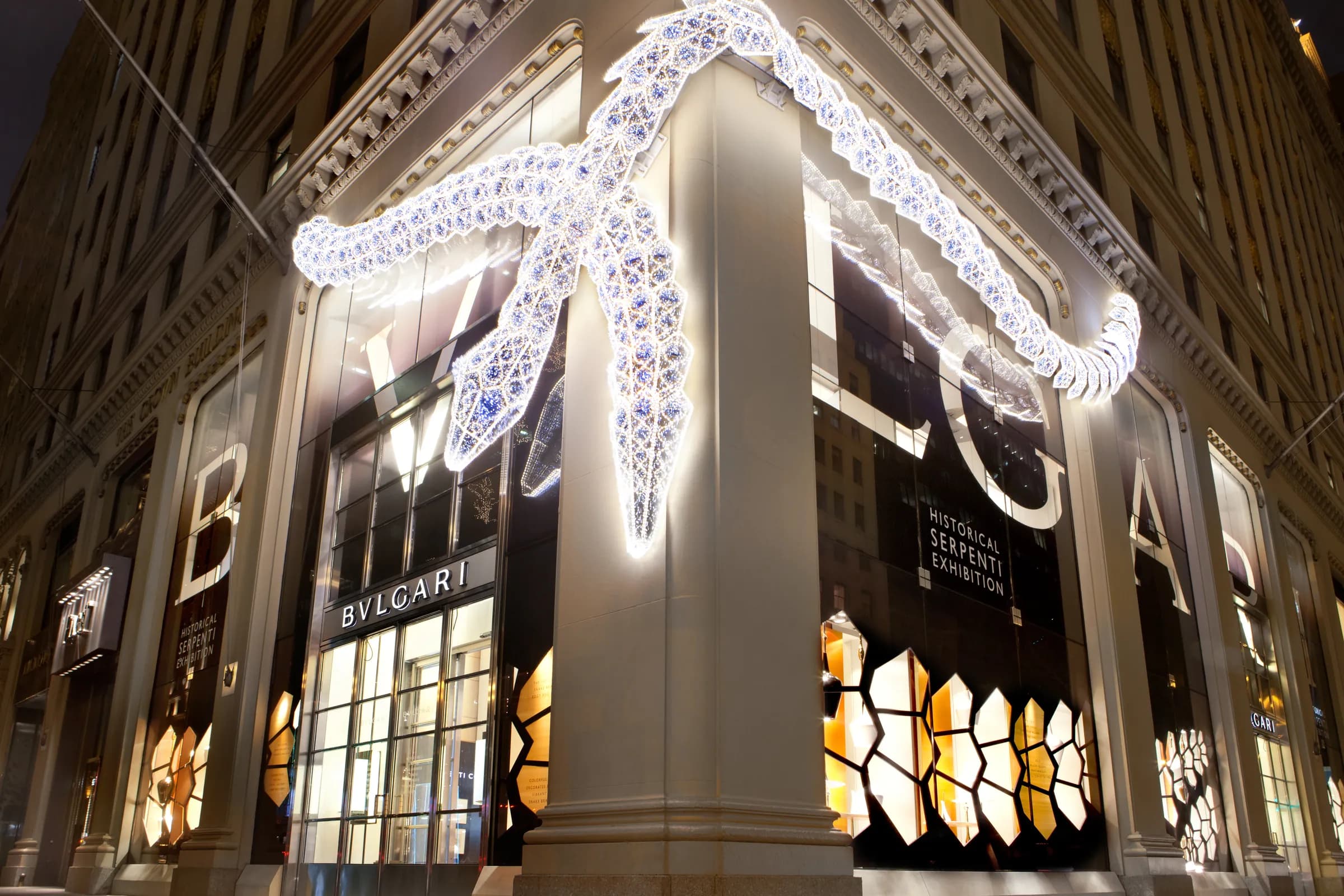
A flagship window is one site, often with the most ambitious engineering. Its risks are technical: structure, light, finish, and an install that has to be right the first time. The Dior 57th Street facade is the extreme case, with structure, graphics and light engineered as one system and pre-fitted in our shop before a Midtown install.
A rollout trades some of that complexity for repetition, and its risks are logistical. Every store needs its own survey, because storefronts differ even when the design does not. Production has to be kitted by site. Freight goes to several cities. Installs run on a schedule where one late store affects the rest.
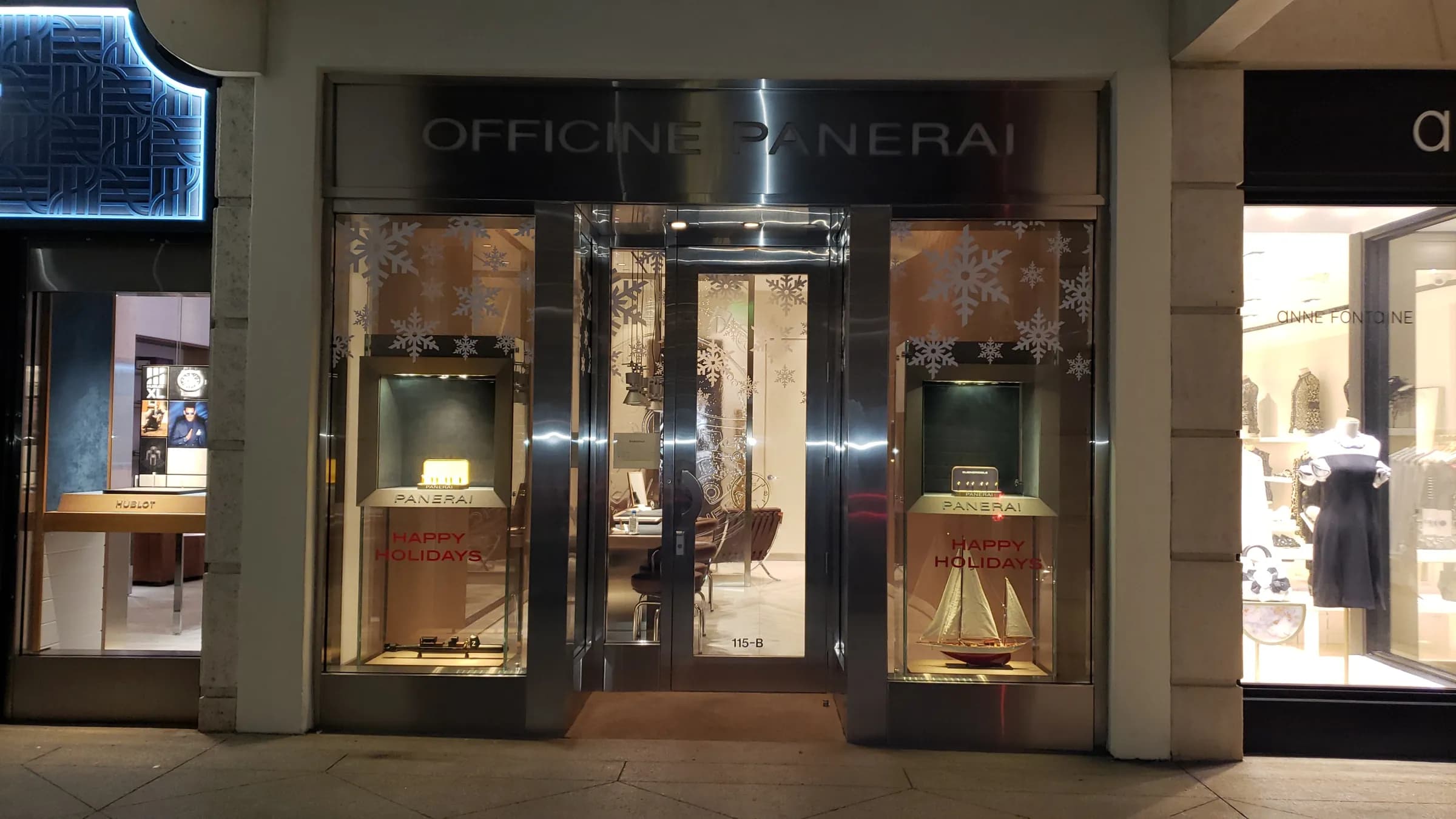
The Panerai holiday windows of 2020 show the rollout model: frosted snowflake vinyl and holiday graphics for five boutiques, from Palm Beach to Vancouver. Different storefronts and cities shared one launch date and needed an identical result. One production run, kitted to each site survey and installed on a single schedule, made that possible.
For a rollout, add time for surveys at the front and for freight and sequencing at the back. The middle of the schedule can look like a flagship's. The ends cannot.
Where the buffer belongs
A buffer placed after the install date is not a buffer; it is a missed launch. Place it before freight, inside the last few weeks, where it can absorb a late approval, a remade part or a slow delivery without moving the install night.
If the buffer is never used, the window arrives early and the install is calm. That is not wasted time. It is the margin that let everything else run to standard.
Plan early, and plan backward
The most useful thing a brand team can do for a seasonal window is fix the install date early, then hold every earlier decision to the date the plan gives it. The craft happens in the shop and on install night, but the schedule decides whether that craft has the time it needs.